03
Category analysis: unattended fresh-drink retail
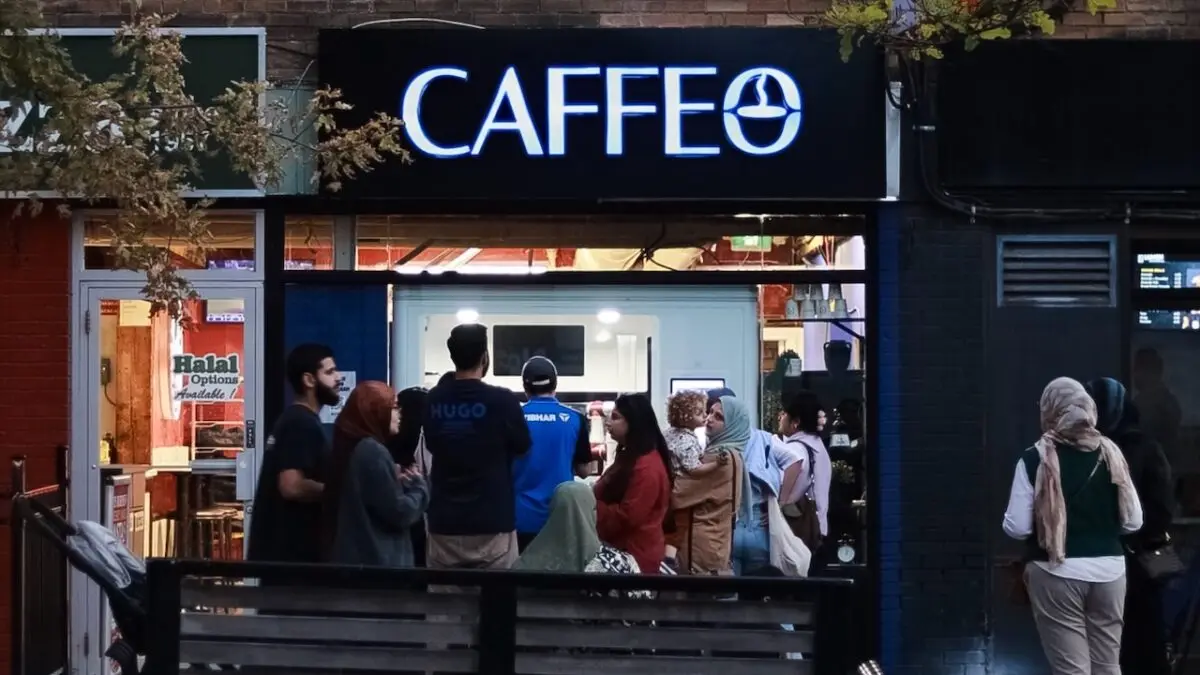 Caffeo, 405 Richmond Street West, Toronto. Photo: Dustin Fuhs, 6ix Retail; credit in Appendix B.
The unattended fresh-drink category has exactly one measured throughput figure in its public record; this chapter is built around it.
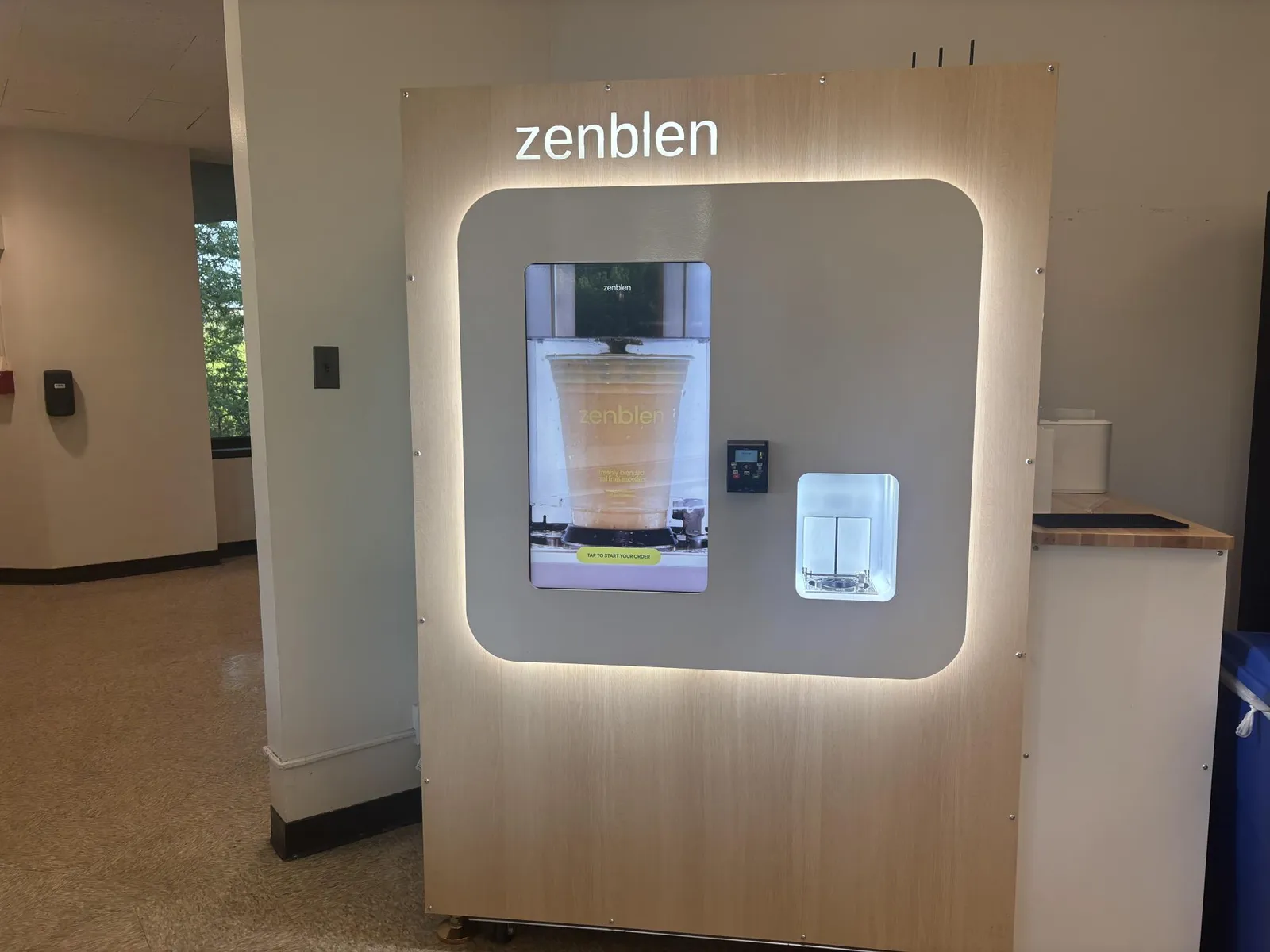
The best-documented operator in the category is Zenblen, a Chicago company running robotic smoothie kiosks. It is presented here as the category’s best evidence, not as a target: it is the operator that has survived, iterated, raised institutional money, and placed units. What its public record shows is therefore the most favourable data available about how this category performs.
Throughput: the one real number
In a 2024 interview, Zenblen’s founder stated the company “served over 2,500 smoothies” from its field unit in 2023.1 Over a full year that is roughly 6.8 drinks per day. The unit sits inside a members-only innovation hub, a captive and friendly population of habitual users. The hub’s own blog places the kiosk on site by May 2022, a year before the counted period, so the 6.8 reads as a mature rate rather than a ramp-up undercount.2 No later or better figure has been published by anyone in the category, in any climate, in any venue class.
Where the units live
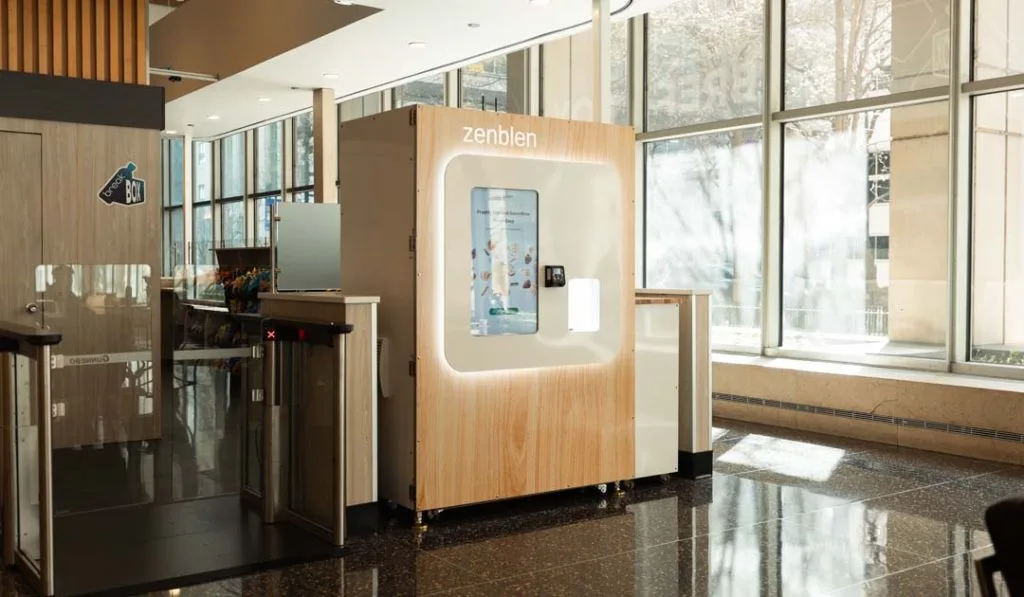
Zenblen lists eleven kiosks: university buildings, hospital towers, a members-only innovation hub, a residential building’s gym, a pilates studio.3 Checking each venue’s own published hours and access rules yields a clean structural finding: every unit sits inside an access-controlled or hours-limited building. None is street-facing; none can be reached by a member of the public walking up off a sidewalk, the use an unattended machine nominally exists for.3
Placement follows procurement, not retail siting. At two universities the kiosks arrived through the incumbent campus vending contractor, a division of Compass Group; the contractor’s regional director, not the startup, speaks for the expansion decision in the campus paper.4 A third campus lists the kiosk as a line item in the vending contractor’s procurement bid.5 The category leader’s distribution, in other words, is the vending industry’s existing rails.
The economics the record supports
On stage in 2026, the founder described two revenue lines: “we get revenue both from our location partners in terms of monthly service fee and we also get retail revenue from each smoothie we sold.”6 No dollar figure has been disclosed for either line. The venue pays for the amenity. The same pitch claims over 550 percent contribution margin, a six-month payback per kiosk, and 99 percent reliability; all are the operator’s own unaudited statements with no disclosed dollar basis, and are labelled here accordingly.6
The retail price point at one campus is US$8 per smoothie, per the student paper.4 The capital side is better documented: two SEC Form D filings confirm US$2,117,117 sold in the 2023 round and US$2,480,647 in the 2025–26 round, a floor of US$4.6 million across the two, against eleven placed units at the time of this audit.7 A US$6 million Series A was described by the founder as “closing” in the same 2026 pitch; no filing or press confirmation existed at this study’s access dates.6 Roughly US$420,000 of confirmed capital per placed unit is the ratio the public record supports.
At the one venue with a published count, cups move at about 6.8 a day. Call it US$54 a day of retail revenue, before costs.
The venue pays for the amenity. This line, not the cups, is what carries the business.
The patent shadow
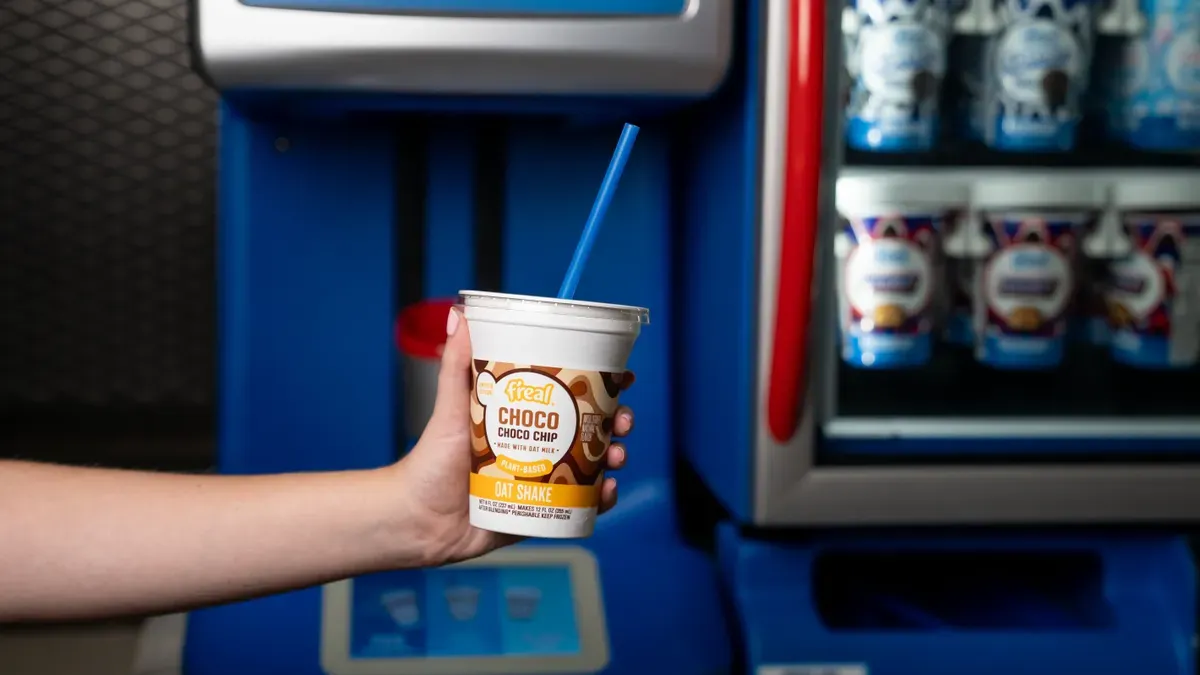
The blend mechanism itself is not open ground. F’real Foods holds two live United States patents on in-cup blending with an elevator assembly and removable spindle, expiring 2033 and 2037.8 A third patent often casually attributed to f’real, US10682942B2, in fact belongs to Tikiz Franchising and covers mobile-kiosk dispensing hardware; the correction matters because the misattribution circulates.8 Zenblen’s own application was allowed but not yet granted at this study’s access date.9 Whether any given built machine infringes the live claims is a freedom-to-operate question the public record cannot resolve; what the record does establish is that a new entrant’s cheapest mechanical path runs near claims that are enforced assets until 2037.
The adjacent evidence
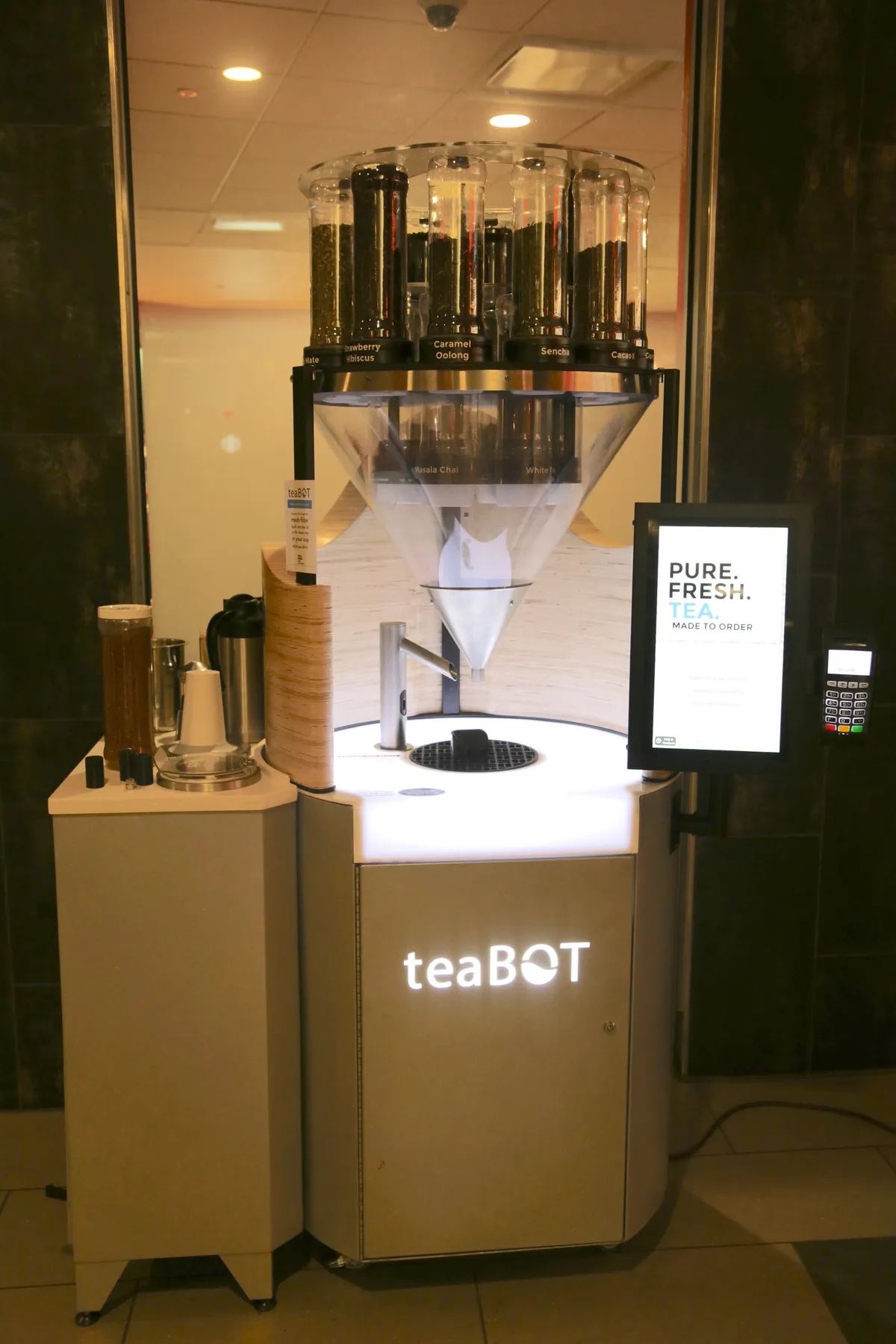
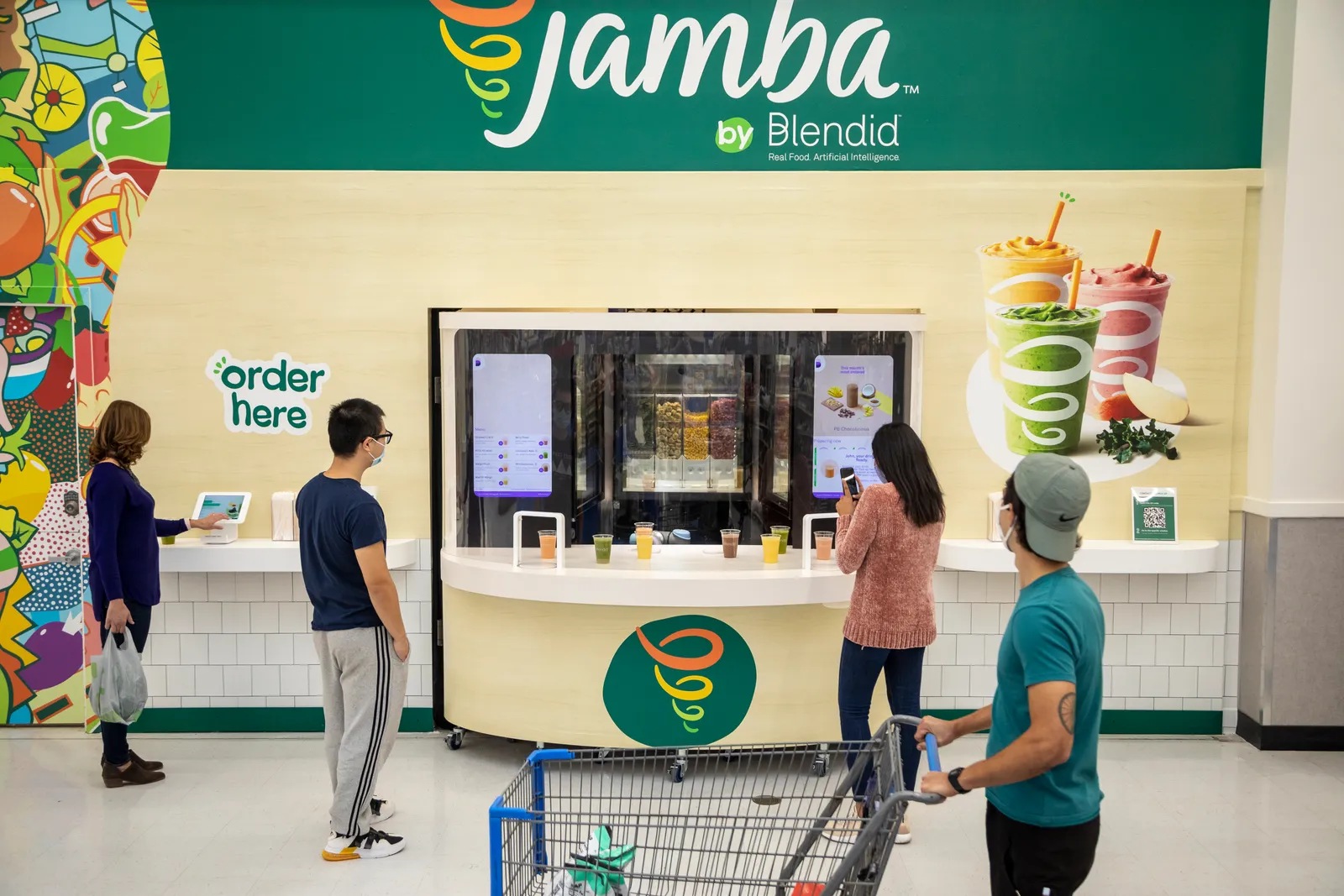
The two nearest comparators reinforce the read. teaBOT, the automated tea kiosk company, remains active after a decade; its chief executive simultaneously serves as Zenblen’s CTO per his own public profile, and appears on Zenblen’s first Form D but not its second.10 Blendid, the robotic smoothie company that raised venture capital for an eight-by-eight-foot robot-arm format, disclosed in its FY2025 annual report substantial doubt about continuing as a going concern, thirteen employees, a $308,000 obsolete-inventory write-off, and the discontinuation of its original kiosk in favour of a smaller, cheaper unit sold outright rather than leased.11 Those are the filing’s own figures, reported without characterization. The direction of travel across the category is uniform: smaller and cheaper machines, venues rather than streets, fees rather than cups.
What the category’s public record supports: unattended fresh-drink machines survive as venue amenities on service-fee economics, inside access-controlled buildings, placed through vending-industry procurement.
What no public record supports: a street-facing unattended fresh-drink store carrying itself on cup margins. Nobody has published a case, and the one measured throughput figure is below every capital stack’s viability line in this study.
Notes
- Ottomate News, “Zenblen brings robo-crafted smoothies” (founder interview), ottomate.news/p/zenblen-brings-robo-crafted-smoothies, accessed 2026-07-14. The 2,500-smoothie figure is the operator’s own; 6.8/day is the naive full-year division.
- mHUB blog, “Hardtech startup Zenblen inspires healthy consumption,” published 2022-05-23, mhub.org, accessed 2026-07-14; IIT Institute of Design article, published 2020-11-05, iit.edu, accessed 2026-07-14.
- zenblen.com/find-a-kiosk, accessed 2026-07-14; each venue’s access reality checked against the venue’s own published hours pages (rush.edu, lib.uchicago.edu, mhubchicago.com, rentnemachicago.com, onyxpilates.com, and others), all accessed 2026-07-14.
- The Daily Northwestern, “Second Zenblen smoothie machine installed in Main Library,” 2026-05-26, accessed 2026-07-14. Canteen (Compass Group) senior regional director quoted on the expansion decision; US$8 price point per a student quoted in the same article.
- College of DuPage vending-services procurement solicitation, June 2025, cod.edu (PDF), indexed via search snippet, accessed 2026-07-14.
- mHUB HardTech Summit pitch (video uploaded 2026-03-25), youtube.com/watch?v=wW6zQRT78pA at 41:28–44:18, auto-caption transcription, accessed 2026-07-14. All figures in that segment are the operator’s own unaudited statements.
- SEC EDGAR, Zenblen, Inc. (CIK 0001993331), Form D filed 2023-09-18 (US$2,117,117 sold of a US$2,840,275 offering, 34 investors) and Form D filed 2026-01-21 (US$2,480,647 sold, offering indefinite, 12 investors), both accessed 2026-07-14. Commonly cited broker figures (US$2.84M, US$3.55M) understate the SEC-confirmed total.
- US9579615B2 (expires 2033) and US10299628B2 (expires 2037), assignee F’real Foods LLC; US10682942B2, assignee Tikiz Franchising, LLC. patents.google.com, all accessed 2026-07-14.
- US20220160162A1, Zenblen, Inc., legal-events table showing “allowed, notice of allowance not yet mailed,” 2026-04-12 as the last indexed event. patents.google.com, accessed 2026-07-14.
- LinkedIn public profile headline (“CEO @ teaBOT + CTO @ Zenblen”), ca.linkedin.com/in/rehmanmerali, accessed 2026-07-14; presence on the 2023 Form D and absence from the 2026 Form D per note 7.
- 6d bytes inc. (Blendid) FY2025 annual report (year ended 2025-10-31, filed 2026-03-02), SEC EDGAR CIK 1830909, accessed 2026-07-14. Going-concern language, headcount, write-offs, and the product transition are the filing’s own disclosures.